


What is a Business Dashboard? (And Why Your Car is the Best Way to Explain It)
When most people hear the word “dashboard” they picture one thing – the panel in front of them when they’re driving. Speedometer, fuel gauge, temperature dial, warning lights. Everything you need to know about how your car is running, right there in front of you, without having to get out and look under the bonnet.
That’s a dashboard.
And a business dashboard works in exactly the same way.
Your business has a bonnet too
When you run a business – whether that’s a handmade shop on Etsy, a service you offer locally, a product you sell across multiple platforms – there’s a lot going on under the bonnet.
Sales coming in. Fees going out. Some products selling better than others. Some months busier than others. Some platforms worth your time, some that feel like hard work for very little return.
All of that information exists. It’s in your Etsy account, your Shopify reports, your bank statements, your stock records. But it’s scattered. It’s in different places. It’s in formats that don’t talk to each other.
So most small business owners do what anyone would do – they check in on things when something feels wrong. They open their Etsy dashboard when an order comes in. They look at their bank account at the end of the month and try to work out if things are going well or not.
That’s a bit like driving your car with the dashboard covered up and only checking the fuel gauge when the engine starts coughing.
You’ll get by. But you won’t know there’s a problem until it’s already a problem.
What a business dashboard actually does
A business dashboard takes all that scattered information – from all the different places it lives – and pulls it into one clear view.
Not a list of numbers. Not a spreadsheet you have to squint at. A visual picture of your business that you can understand in seconds.
Think back to your car.
When you glance at your dashboard while driving, you don’t sit there doing mental arithmetic. You don’t calculate whether your speed is appropriate based on a table of figures. You see a needle pointing at a number and you know immediately whether you need to slow down, speed up or fill up with petrol.
A business dashboard does the same thing – but instead of speed and fuel, it shows you things like:
Revenue – how much money is coming in
Profit – how much of that money you actually get to keep after costs and fees
Best-selling products – what people are buying most
Most profitable products – what’s actually making you money (not always the same thing as what sells most)
Seasonal patterns – which months are your busiest, and which to prepare for
Platform performance – if you sell in more than one place, which one is worth the most to your business
All of it. One screen. Updated automatically.
The bit people are always surprised by
Most small business owners, when they first see a proper dashboard for their business, say the same two things.
First: “I didn’t know I could have this.”
Second: “I wish I’d had this sooner.”
Because the information was always there. It was always being collected by their platforms, their payment providers, their order systems. Nobody had ever just shown it to them clearly.
One seller I worked with discovered that her most popular product – the one she made the most of, promoted the hardest, built her whole Christmas range around – was making her less than £1 profit per sale after Etsy fees and materials. She had no idea. Her dashboard made it visible in seconds.
That’s what a dashboard does. It turns your data from something that sits in a spreadsheet nobody looks at, into something that actually changes how you run your business.
Do you need to be “good with numbers” to use one?
No. That’s the point.
A well-built business dashboard isn’t designed for data analysts or accountants. It’s designed for the person who started their business because they love what they do – not because they love spreadsheets.
You shouldn’t have to understand how the information is calculated. You just need to be able to read it and act on it.
The same way you don’t need to understand how a speedometer works in order to know you’re going too fast.
What a dashboard isn’t
It’s worth saying this clearly, because there’s sometimes confusion.
A dashboard isn’t a replacement for your accounts or your bookkeeping. It doesn’t file your tax return or replace your accountant.
It’s also not a crystal ball. It shows you what has happened, so you can make better decisions about what happens next.
And it’s not complicated software that needs a team to run it. The Clarity Dashboard, for example, is built in Excel – something most people already have on their computer – and takes less than an hour to set up. After that, it takes about two minutes to refresh every time you want to see updated figures.
The dashboard your car would never let you drive without
Imagine if car manufacturers decided that dashboards were too complicated for most drivers, so they just removed them. You’d have to pull over, get out and check the engine every time you wanted to know how fast you were going.
Nobody would accept that for their car.
But most small business owners are running their business exactly like that – checking things one at a time, in different places, when something feels off, rather than having everything in front of them at a glance.
A business dashboard fixes that. Simply. Affordably. Permanently.
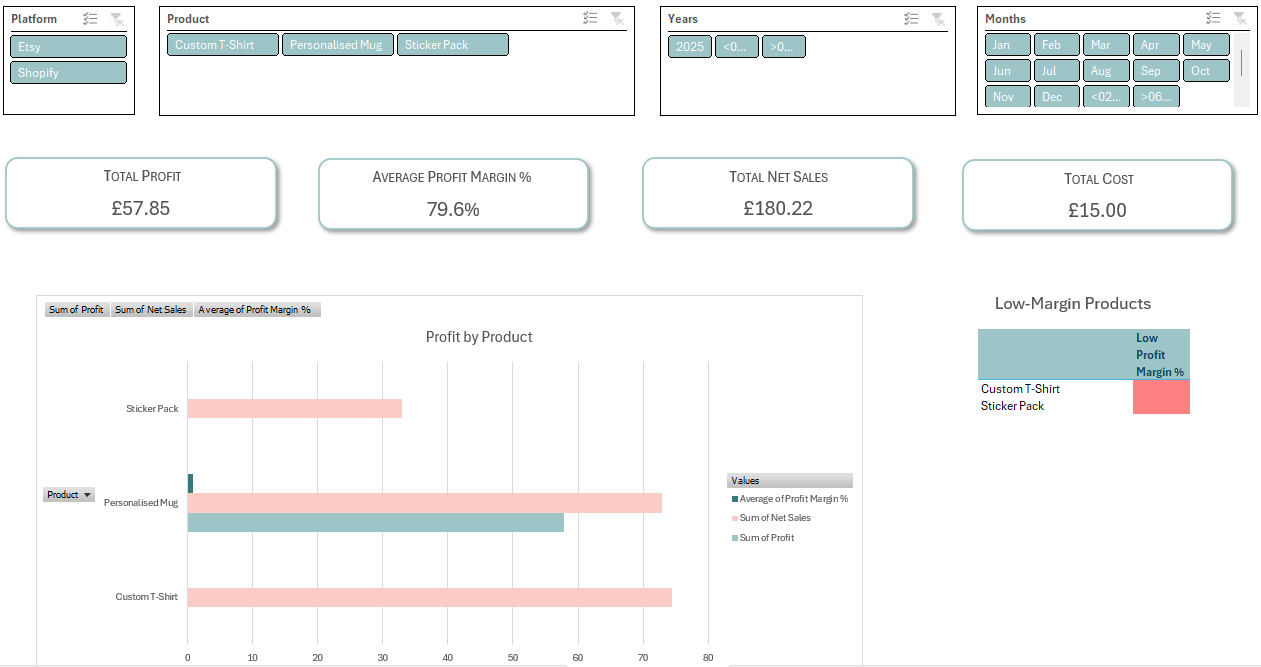
Ready to see what your business looks like with a proper dashboard? The Clarity Dashboard Bundle is built specifically for online sellers and small product businesses – Etsy, Shopify, TikTok Shop, Faire, WooCommerce and more. One-time payment. Yours to keep forever. Find out more
Not quite ready yet? Download the free True Profit Per Product Calculator and start getting clear on your numbers today – no purchase needed. Get it free